How many times in your life have you smashed one of your favourite mugs, plates or bowls? Sometimes it just slips out of your hands, other times time works its magic and one day a crack appears, the ear remains in your hand …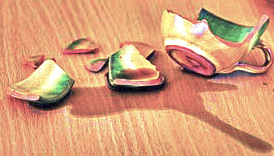
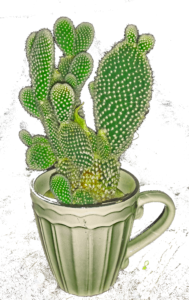 If it is a very precious or favourite piece of yours and it has not cracked to too many shards, you might want to try to fix it so that it would not be visible repair. Then you can use such a mug, for example, for pencils, plate or bowl under the flower. But only if you can get it together in such way that it is not at first sight recognizable. Otherwise, you just throw it away.
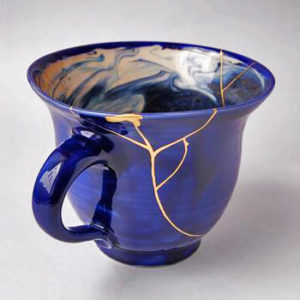
But it can be done differently. You can on the contrary repair such a piece so its repair stands out, it is shining in the distance and making so a new original piece in its way.
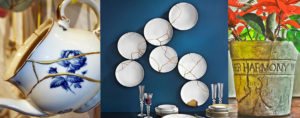
In Japanese culture, you can find Kintsugi art (translated to “golden joinery”) or Kintsukuroi (“golden repair”) – which can be briefly described as an art of repairing broken ceramics with a lacquer dusted or mixed with gold, silver or even platinum powder. It is believed that sometimes the repair of broken things can make them even better and more beautiful than if they were new.
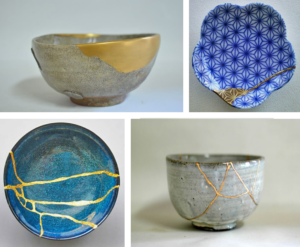
This way of repair celebrates the unique history of each artefact by emphasizing its breakages, cracks or even missing parts instead of hiding or disguising them. Kintsugi often makes the repaired piece even more beautiful than the original, reviving it with a new life.
History
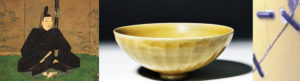 The art of Kintsugi dates back to the end of the 15th century. According to one legend, this art came into being when Japanese shogun Ashikaga Yoshimasa sent a cracked Chinese chawan (a tea bowl) back to China for a repair. After its return, Yoshimasa was disappointed to find that this was corrected by unsightly metal staples. This motivated his craftsmen to find an alternative, aesthetically pleasing method of repair. And so Kintsugi was born.
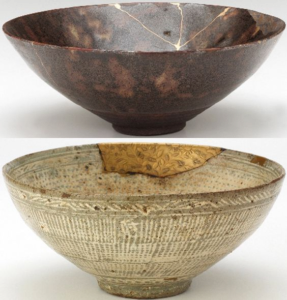 Collectors were so enchanted by this new art that some were accused of deliberately breaking valuable pottery to repair it with the golden Kintsugi seams. Kintsugi became closely associated with the ceramic vessels used for the Japanese tea ceremony – the chanoyu. However, over time, this technique has also been applied to ceramic pieces of non-Japanese origin, including China, Vietnam and Korea.
Philosophy
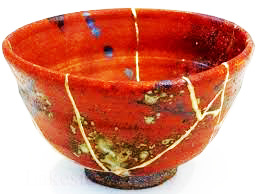 Since its inception, Kintsugi technique has been connected and influenced by various philosophical thoughts. Specifically, with Japanese philosophy wabi-sabi, which calls for beauty to be seen in flawed or imperfections. This way of repair is also associated with the Japanese feeling of mottainai, which expresses regret when something is useless or thrown away, as well as mushin – freedom from premature trials and presumptions.
Basic methods
There are three predominant Kintsugi styles: crack repair, piece recovery method, and joint-call method. While, in any case, gold-dusted compound/epoxide is used to repair the broken ceramics, the remedies themselves differ a little from each other.
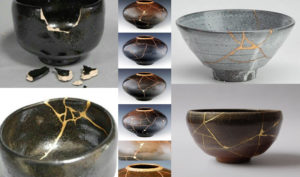 Crack repair method – use of gold dust and resin or lacquer to fix broken pieces with minimal overlapping or filling of missing pieces
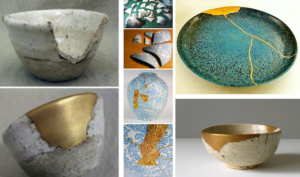 The piece recovery method – if a ceramic fragment is not available, it is produced and supplemented exclusively by epoxy resin – golden mixtures
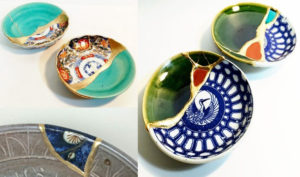 Joint call method – the missing piece of ceramics is replaced by a similarly shaped but inconsistent fragment of aesthetically different ceramics. It combines two visually different works into one unique piece. It is a method reminiscent of the well-known patchwork.
Present time
Kintsugi inspires many artists and craftsmen all over the world even today. And it does keep this ancient tradition alive. Works inspired by this technique can be found in many world museums and galleries.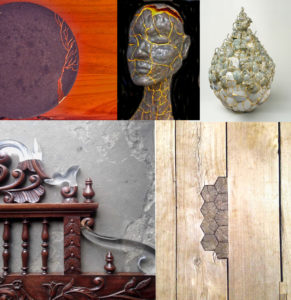
But it can also inspire us. The next time we will not want to throw away a crackled saucer from a grandmother’s set, a broken cup we liked, or just an old flower pot … We can also take the breaks and subsequent repair as part of the history of the object, rather than something that should be disguised.


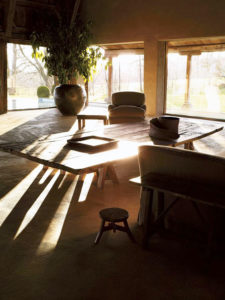 He gained the love for all the old and authentic and a certain fascination by the Middle Ages, the Renaissance and the Baroque, in his youth, when he helped his mother with the reconstructions of old houses in the Vlaeykensgang – the historic district of Antwerp, which was then rented to local artists. To this he later, thanks to business travels throughout Thailand, Cambodia and Japan, added an admiration for Eastern philosophies and art.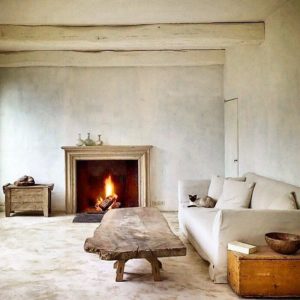
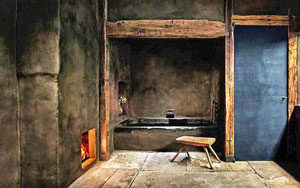 For some, his combination of materials and styles may seem contradictory, but Vervoordt believes that truth may be contained in a paradox and in ambiguity.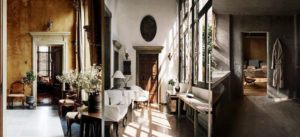
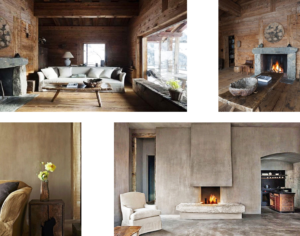
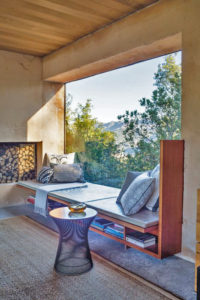 The home should always be a place where you can forget about the difficulties of the surrounding world. A home based on wabi-sabi should be a place where you feel absolutely free and unrestrained, to relax, to meditate, but also to create and develop your creativity.
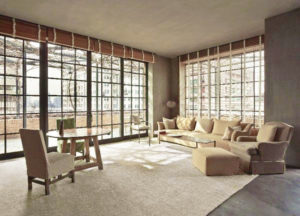 For an at least partial transformation of our home into the wabi-sabi style we do not need great finance or even a designer work. A few little steps might just be enough.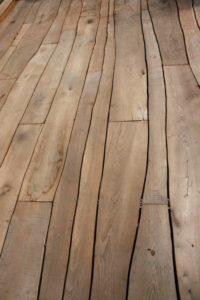
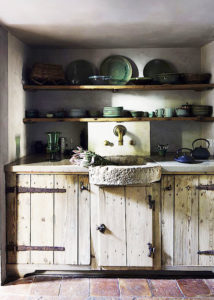
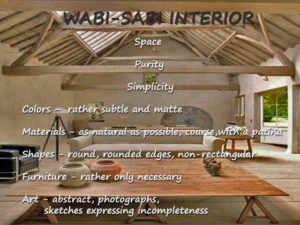
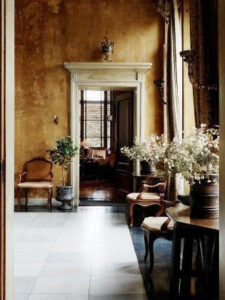 As already mentioned – space, light, purity and simplicity – these are the fundamental principles of wabi-sabi interior. You probably won’t enlarge your room by any magic wand, but sometimes it’s enough to just move a piece of furniture into the corner or to think about the necessity of having some of our stuff. Cleanliness (purity) is practised not only figuratively, but literally. With the cleanliness of our home, we express our respect for our visitors, but above all that we respect ourselves. By keeping surfaces free of dust and dirt we deliver to our space the desired feeling of peace and order.
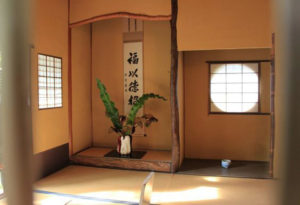 Try the old Japanese method of ROTATING PRECIOUS ITEMS. Japanese hid their valuables and were displayed just a few of them in a specially designated area or in a special niche – tokonoma. After a certain time, they realigned them. Assuming we have storage space, we just hide these little things and our valuable belongings and display only a few of them at a time. After some time, we replace them with another from our “warehouse”. This method is far less painful than just getting rid of our “valuables.” Moreover, after some time when we do not have them all the time in our eyes, they will seemingly come off as even rarer or on the contrary, suitable for throwing out or handing over.
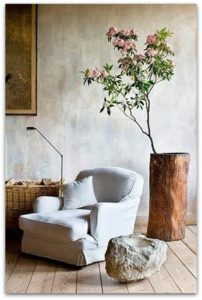 The wabi-sabi style is not suitable for supporters of consumerism. On the contrary, it is inclining towards a sustainable environmental approach. Things and equipment made of quality natural materials and in good quality design are not hurt by time or a gentle usage. Getting a patina of time often rather benefits them. And we do not change such things so often.
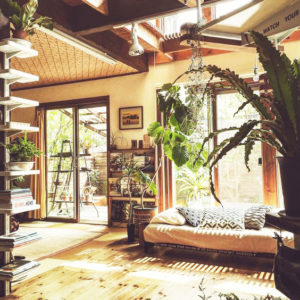 To make our home really a place where we feel absolutely free, freely, fetterless, we should listen to our feelings and take heed of our intuitions when arranging it. In that way, we use colours, materials, and objects that we love and that are pleasing to us.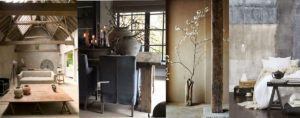
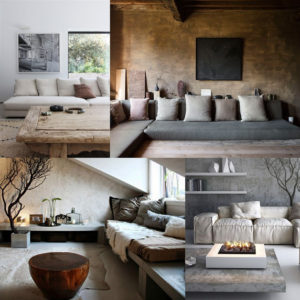 The wabi-sabi style is not suitable for supporters of consumerism. On the contrary, it is inclining towards a sustainable environmental approach. Things and equipment made of quality natural materials and in good quality design are not hurt by time or a gentle usage. Getting a patina of time often rather benefits them. And we do not change such things so often.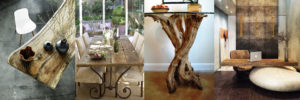
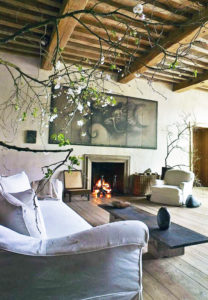 If you’ve recently found demonstrations of interiors in the style of wabi-sabi in magazines, they were often very expensive residences. And often they are also homes of more or less well-known people (
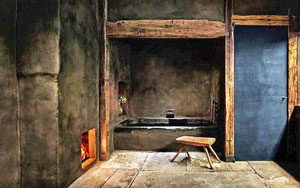
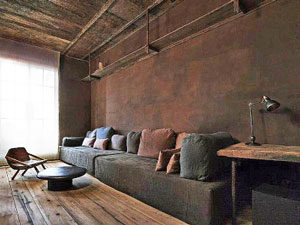
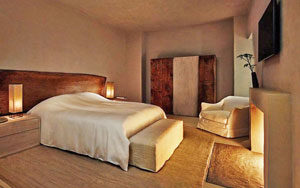
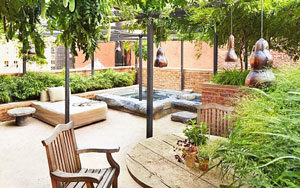
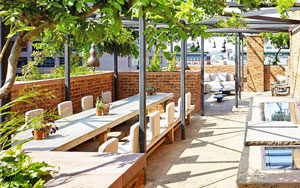
 Manhattan, New York – a centre of global stock exchange and the location of the headquarters of commercial banks, in a way a place of luxury and pomposity, a place of a constant city rush. In a sense, a symbol of Western capitalism. You could describe this place with a lot of adjectives but definitely not calm and modest. And still, in Tribeca, a 2000 square meter large, two stories high rooftop apartment was reconstructed, a penthouse in the style of the wabi-sabi philosophy for a very famous man.
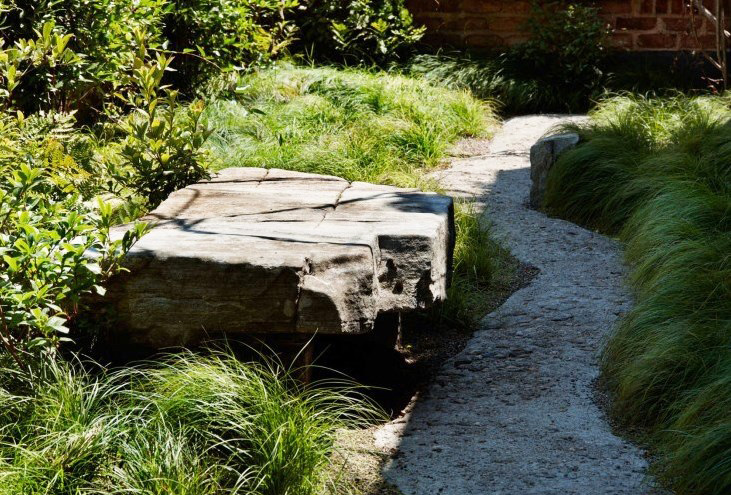
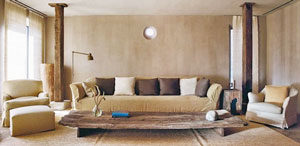 All that using a minimalistic design, seemingly incompatible architectural elements, interesting recycled materials from the vicinity, antique furniture from Asia and Europe. This sustainable design is noticeable on the entire interior and exterior.